
Valve cores are small parts inside a tire valve, but they are very important for tire safety and proper inflation. Over the years, three main types of valve cores have become common worldwide: the American valve core, the Presta valve core, and the German (Dunlop/Woods) valve core. Each type is different in size, sealing method, and pressure limit, so different vehicles use different valve cores to match their needs.
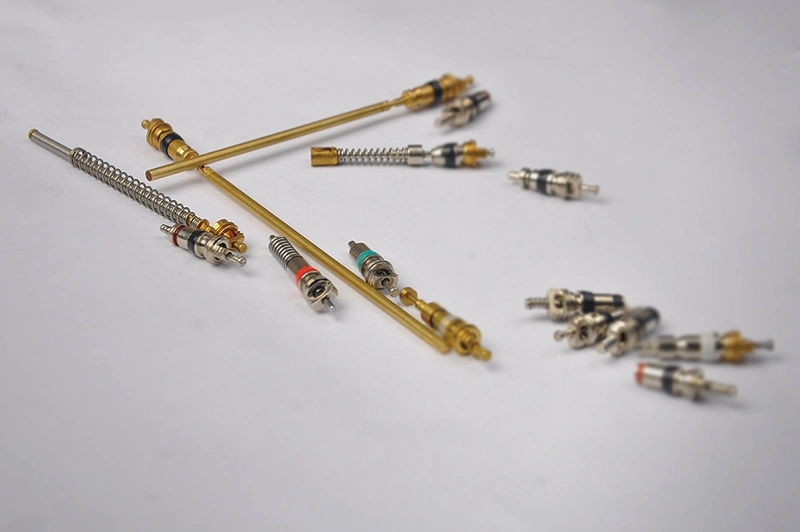
The American valve core is the most common type. It has an 8 mm brass shell with nickel plating and a metal spring that seals the air. It works well under high pressure, over 1.0 MPa. Cars, motorcycles, and even heavy machines often use it. Reinforced versions are made for very high pressure. Its strong, stable, and standard design makes it the first choice for most vehicles.
The Presta valve core, also called the French valve core, is mainly for high-pressure bicycle tires. It has a thin 6 mm stainless steel rod with a small nut at the tip. It is very light but can handle pressure up to 1.5 MPa. Road bikes, racing bikes, and tubeless tires usually use this type. Its thin shape is easy to recognize and popular among cyclists.
The German valve core, also called Dunlop or Woods valve core, is simpler and older. It has an 8 mm rubber tube and an umbrella-shaped seal. It can hold about 0.8 MPa pressure. It is not for high-pressure use, but it is easy to fix and cheap. Many city bikes and some electric bikes in Europe and Asia still use it.
Even today, these three types of valve cores are important. Each one fits different vehicles and pressure needs. Together, they form the base of tire valve core technology worldwide, keeping vehicles safe and tires working properly.









Copyright © 2025 by Tontron Precision Technology (Shandong) Co., Ltd. All Rights Reserved
Datenschutzrichtlinie